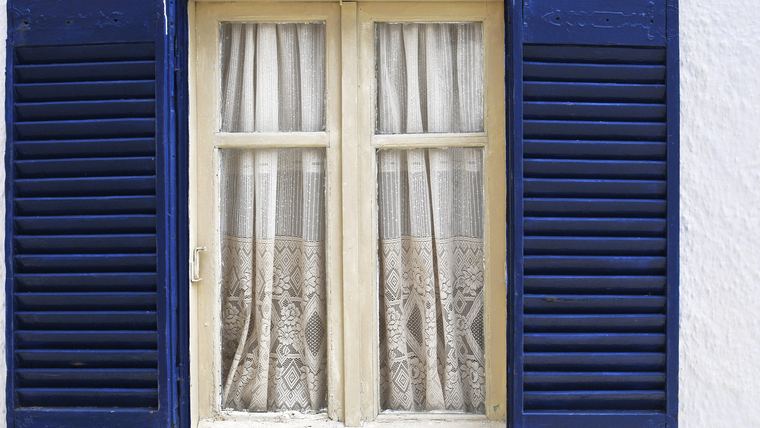
What to expect
| Typical duration | Interior house 1–2 weeks · full exterior 1–3 weeks |
|---|---|
| Cost band | Figures live in the cost index |
| Permit required | Colour is controlled in designated settlements |
| Seasonal constraint | Exterior best spring and autumn — not August heat or winter storms |
Why lime, and when not
Traditional walls here — stone, lime mortar, lime plaster — are designed to get damp and dry out again. The finish is part of that system. Lime wash is vapour-open: moisture passes through it and evaporates from the face.
Modern acrylic masonry paint does the opposite. It forms a film. Moisture in the wall reaches the back of the film, cannot pass, and pushes the coating off in sheets, usually taking the top layer of plaster with it. Repainting over that with something better is money spent to repeat the process.
The honest exception: modern render on a modern block or concrete wall with no moisture path behind it is perfectly happy with a good acrylic system, and lime would be a needlessly high-maintenance choice. The material decides, not tradition.
The exterior cycle nobody mentions
Lime wash is not permanent. In the traditional settlements it was renewed regularly — that maintenance cycle is the reason those villages look the way they do, and it is a running cost rather than a one-off.
| Situation | Typical interval | Governing factor |
|---|---|---|
| Sheltered interior | Long | Wear rather than weather |
| Inland exterior, sheltered elevation | Moderate | UV |
| South and west elevations | Shorter | UV and thermal cycling |
| Within spray of the sea or caldera face | Shortest | Salt plus UV plus wind-driven rain |
| Rental property front elevation | Driven by appearance, not failure | Guest photographs |
Deliberately given as relative intervals rather than years — actual life varies enormously with exposure, substrate and the system used, and a specific figure would be a guess.
Colour in a designated settlement
In a designated traditional settlement the external colour is not a free choice. Palettes are controlled, and repainting an elevation a colour outside the permitted range is a compliance problem rather than a taste dispute.
This catches new owners regularly — particularly the assumption that any shade of blue is acceptable because the island is associated with it. It is not that simple, and the answer is settlement-specific. See traditional settlement compliance.
What this trade covers
- Lime plaster finishing and lime wash on traditional and cave buildings.
- Removal of failed impermeable coatings back to sound substrate — the unglamorous half of most exterior jobs here.
- Modern breathable and conventional systems on contemporary render.
- Interior decoration, including the preparation that makes it last.
- Exterior repainting cycles for rental and hotel properties, scheduled into the closed season.
- Efflorescence and salt-damage treatment on affected walls.
- Colour scheme advice within the permitted range in designated settlements.
Questions people actually ask
Why does my exterior paint flake off in sheets?
Almost always an impermeable coating on a wall that carries moisture. The wall cannot dry outwards, moisture collects behind the film and detaches it. Another coat repeats it — the fix is stripping back and rebuilding with a breathable system.
Can I paint my house any colour?
Outside a designated settlement, largely yes. Inside one, no. The controls are real and enforced, and it is worth asking before buying paint rather than after.
How often does the outside need repainting?
It varies far more with exposure than with product. A sheltered inland elevation and a caldera-facing wall in salt spray are different problems. We will give you an honest interval for your specific building rather than a marketing figure.
Is lime wash more expensive?
The material is cheap; the labour is higher because it is applied in more coats and needs the right conditions. Over a building's life it is usually cheaper, because the alternative includes periodically stripping failed coatings and repairing the plaster underneath.
Can you paint in summer?
Interiors yes. Exteriors in full August sun are poor practice — coatings applied to a surface that hot do not form properly. Spring and autumn give much better results, and that is when we schedule them.