What to expect
| Typical duration | Pedestrian lanes and steps — hand and mule haulage |
|---|---|
| Cost band | Highest access premium on the island |
| Permit required | Designated traditional settlement — strictest controls |
| Seasonal constraint | Peak-season working heavily constrained by visitor volume |
The ground and the access
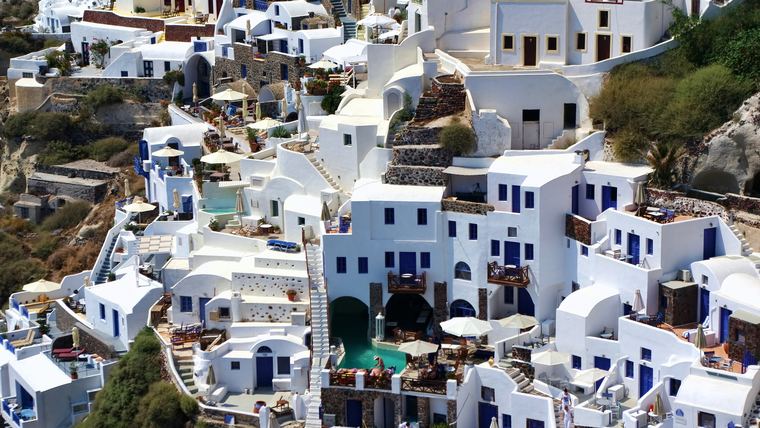
Oia sits on the northern end of the caldera rim, and the settlement is built into and onto the face. Ground varies over very short distances — welded tuff where the yposkafo were cut, looser material above and in the built-up terraces between.
Access is the defining fact. A vehicle can reach the periphery and the main approach, and beyond that the settlement is stepped pedestrian lanes, many of them narrow enough that two people cannot pass carrying material. Every bag of sand, every window, every kitchen unit and every barrow of demolition waste travels that route on foot or by mule.
The consequence for a budget is direct and it is the number owners most often get wrong. Material handling on an Oia job is not a line item, it is a multiplier on almost everything, and it applies twice — once bringing material in and once taking waste out. A quotation for an Oia property that reads like a quotation for Monolithos has not understood the site.
What is built here
Oia's stock is dominated by yposkafo — cave houses cut into the tuff — with built faces and portals where they meet daylight, and later conventional additions built onto and above them. Much of it has been converted to tourist accommodation over the past thirty years, frequently in stages and not always with permits.
- Vaulted cave rooms where the geometry is structural and any alteration is an engineering question. See yposkafo excavation.
- Cement render and plastic paint applied over lime during earlier renovations, which is the single most common defect found here. See cave house damp proofing.
- Terraces over occupied rooms, which is most of Oia — a terrace here is nearly always somebody's ceiling. See waterproofing.
- Unauthorised additions from the conversion boom, which surface at sale or at the next permit application. See legalisation.
What matters most on a job in Oia
- Plan the haulage route before pricing anything. It governs the method, the programme and a large share of the cost.
- Test every elevation against the settlement controls early. Oia is where schemes get sent back, and a resubmission moves everything. See traditional settlement compliance.
- Solve the plant positions in the design. Condensers, solar and pool equipment cannot sit on a visible elevation here, and the settlement is visible from the water, the path and the neighbours above.
- Assume the property has been altered. Compare what is built against what is permitted before committing to a design.
- Programme around the season. Working in the middle of the settlement at peak visitor volume is slow, constrained and unpopular with every neighbouring business.
Questions people actually ask
How much more does building in Oia cost?
Materially more than an accessible site for the same specification, and the driver is haulage rather than labour rates. A contractor prices it from the actual route rather than applying a percentage, because the difference between a property fifty metres from vehicle access and one three hundred metres down is large.
Can you get a bath, a kitchen or a large slab down to my property?
Usually, with the route surveyed first. Occasionally it changes the specification — a jointed worktop instead of a single slab, for example. That is much better decided at selection than on delivery day. See marble and granite.
Can I install air conditioning in Oia?
Yes, with the condenser concealed or screened. It cannot sit visibly on an elevation. This gets designed rather than solved on installation day. See air conditioning.
Can I put in bigger windows for the view?
The opening proportions are controlled and enlarging them is both a permit matter and, in a vaulted building, a structural one. There is often a better answer that gets you more usable light without a refusal.
Do you work in Oia in summer?
For emergencies and small works, yes. For anything substantial we would push it to the closed season — working in the settlement core at peak volume is slower, more expensive and harder on everyone around you.