What to expect
| Typical duration | Second sea crossing for everything; limited on-island access beyond |
|---|---|
| Cost band | Highest logistics premium; plant must be shipped |
| Permit required | Traditional settlement character — check the specific property |
| Seasonal constraint | Crossings weather-dependent; winter access less reliable |
The ground and the access
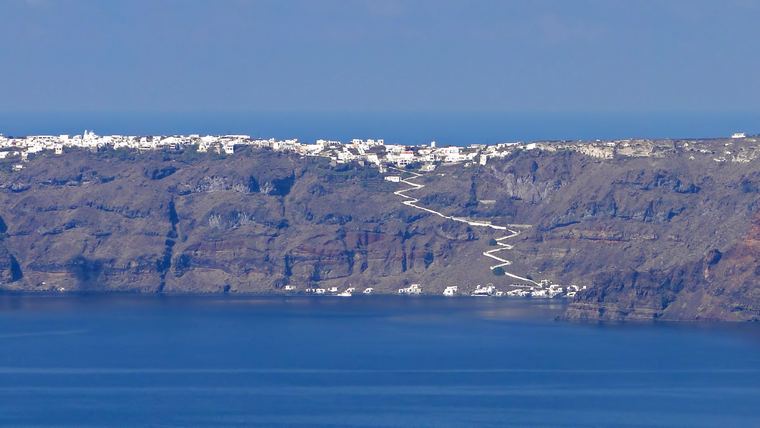
Therasia is the island across the caldera from Santorini, the remaining fragment of the pre-eruption ring. It is small, quiet, and geologically the same story: layered eruption deposit, caldera face on the eastern side, ordinary inland ground behind.
Every construction constraint on Santorini applies here and then one more is added on top. Material that has already crossed from the mainland to Santorini has to cross again. Plant has to be shipped. There is no merchant to visit when something is missing, and no hire yard when a machine breaks down.
The practical consequence is that a Therasia project is planned to a level of detail that would be excessive on Santorini. Everything is scheduled, staged and double-checked before it leaves, because the recovery time from an omission is a boat rather than an hour.
What is built here
Traditional village housing, carved and vaulted property, agricultural buildings and terracing, with a small and growing amount of tourism development.
- Traditional stone and vault construction needing compatible lime materials. See masonry and stonework.
- Carved cave dwellings with the same structural and moisture logic as Santorini's. See cave house renovation.
- Cisterns, which on an island with even less infrastructure are more than heritage features. See water cisterns.
- Agricultural terracing, extensive and requiring drainage-respecting repair. See retaining walls.
What matters most on a job in Therasia
- Plan to a level that feels excessive. Every item scheduled and staged. A missing bag of fixings costs a day here.
- Ship plant deliberately, not reactively. What goes over stays until the job is done, so the plant list is decided at the start.
- Carry more float in the programme. Two crossings and weather dependency compound.
- Assume nothing is available locally. There is no merchant to fall back on.
- Consider reusing spoil and reclaiming material on site. On Therasia this is worth more than anywhere, because everything removed also crosses by boat.
Questions people actually ask
Do you actually take work on Therasia?
Yes, routinely. It requires more planning than a Santorini job and a contractor prices it honestly rather than pretending the logistics are the same.
Why is it more expensive?
A second crossing for every delivery, shipping plant rather than hiring it, and no local supply to fall back on. It is logistics rather than labour rates.
What happens if something is forgotten?
It waits for a boat. That is exactly why the planning discipline on a Therasia job is higher than on Santorini — the cost of an omission is disproportionate.
Are the buildings the same as on Santorini?
The same traditions and the same geology — stone, vaults, carved rooms, cisterns and terracing. The technical requirements are identical; the logistics are not.
Can you work here in winter?
With more float in the programme. Crossings are weather-dependent, and winter compounds that in a way it does not for a road delivery.