What to expect
| Typical duration | Repointing 1–3 weeks · new stone wall 2–6 weeks |
|---|---|
| Cost band | Figures live in the cost index |
| Permit required | External stonework controlled in designated settlements |
| Seasonal constraint | Avoid mortar work in extreme heat |
How the wall was designed to work
A traditional wall here is stone laid in a lime mortar that is deliberately weaker than the stone. That is the whole design. When the wall moves, the mortar cracks; when moisture and salt migrate, they crystallise in the mortar. Both are sacrificial and both are repairable — you repoint, and the wall carries on.
Repoint the same wall in cement and you invert it. The joints are now harder than the stone. Movement is taken by the stone face, and salts crystallise in the stone instead of the joint. Within a few years the stone faces start spalling, and stone is not something you can simply rake out and replace.
This is the single most consequential decision on old-wall repair, and it is routinely got wrong because cement is faster, cheaper and available.
What this trade covers
- Repointing in a lime mortar matched to the original for strength, colour and grain — including raking out failed cement pointing, which is slow, careful work.
- New stone walling in local material, for boundaries, terracing, and elevations in designated settlements.
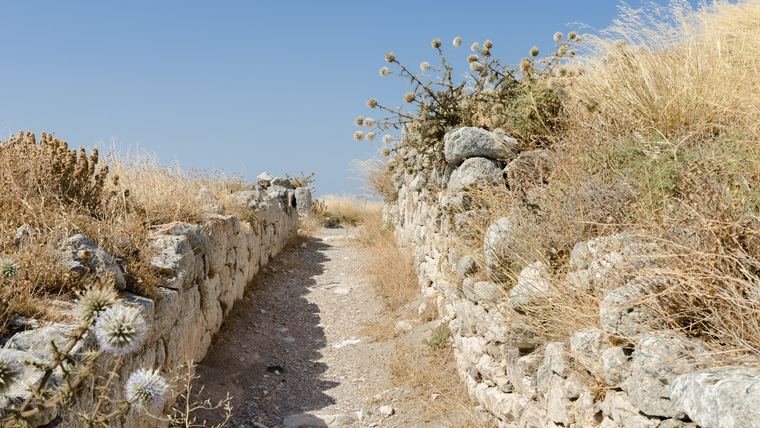
- Dry stone (ξερολιθιά) terracing and retaining, which drains through itself by design. See retaining walls.
- Structural repair — rebuilding collapsed sections, stitching cracks, forming proper heads over openings that were cut without them.
- Grout injection where a rubble wall has lost its core and become two skins with a void between them.
- Careful dismantling and reclamation, so original stone from a demolished section returns to the building rather than leaving on a ferry.
- Arch and vault repair on traditional buildings, coordinated with an engineer where the geometry is structural.
Matching in a designated settlement
In a protected settlement, stonework is not only a construction question. Material, coursing, joint width and finish are part of what the settlement rules control, and a wall that is structurally perfect but visually wrong will be a problem at approval.
Reclaimed local stone helps twice: it matches, and it demonstrably belongs to the building. Where new stone is needed we source locally and lay it to match the existing coursing rather than to a modern regular pattern, which is the detail that most often gives away a recent rebuild.
Salt in old walls
Walls close to the sea, and walls that have been kept damp by an impermeable render, accumulate salts. When the wall finally dries, those salts crystallise at or just under the surface and force the face apart — you see it as a white bloom, then as crumbling.
Treating the bloom is cosmetic. The actual repair sequence is: stop the water getting in, let the wall dry through a vapour-open finish, remove or poultice salts where the concentration warrants it, and repoint or re-render in compatible material. Doing the last step first is why the problem comes back.
Questions people actually ask
Can you repoint with cement to save money?
We will not on a lime-built wall. It is cheaper on the invoice and considerably more expensive over the wall's life, because the damage transfers to the stone. On a modern wall built in cement, cement pointing is correct.
Where does the stone come from?
Local volcanic stone where possible, and reclaimed material from the building itself wherever there is any. In a designated settlement that matters for the approval as much as for the look.
My stone wall has a bulge. Is it serious?
It can be. A bulge often means the wall has separated into two skins with a failed core, and it warrants an engineer's look before deciding between grouting, stitching or rebuilding that section.
Can you build a dry stone terrace wall?
Yes. It is a real skill, it is slower than blockwork, and it produces a wall that drains through itself — which is why the traditional terraces are still standing. See retaining walls and terracing.
What is the white powder on my wall?
Efflorescence — salts brought to the surface by moisture and left behind as it evaporates. It is a symptom. Brushing it off treats nothing; finding where the water is coming from does.