What to expect
| Typical duration | Pedestrian streets in the core; vehicle access inland |
|---|---|
| Cost band | Moderate to high in the core; low a few streets back |
| Permit required | Designated traditional settlement in the core |
| Seasonal constraint | Core is effectively closed to major works in high season |
The ground and the access
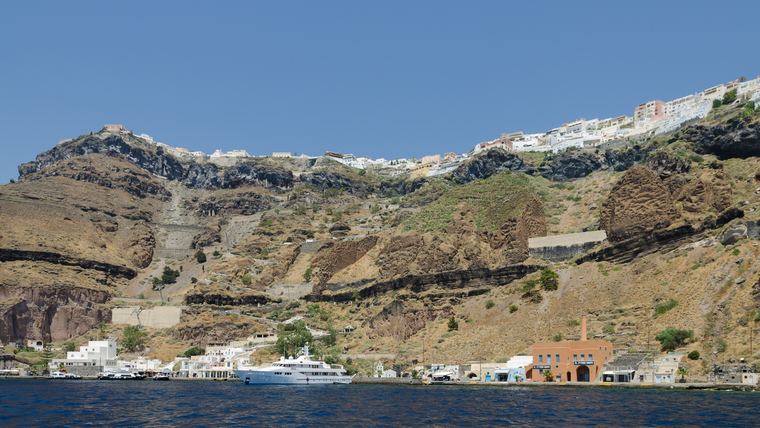
Fira spans two quite different situations within a few hundred metres. On the caldera side, property is built onto and into the face with all the constraints that implies. A few streets inland, the ground is ordinary, the streets take vehicles, and construction is far more conventional.
The core is pedestrian, and it is also the island's commercial centre. Deliveries into it are constrained by time of day, by the volume of people, and by the fact that the route to your site is the shopfront of somebody whose whole year depends on the next four months.
That commercial density is the practical governing constraint. Almost every property here has a business either in it, above it or beside it, and a programme that ignores that will find itself unwelcome and slow.
What is built here
The broadest range on the island: caldera-edge cave and vaulted property, dense multi-storey commercial buildings, apartment blocks, hotels of every size, and ordinary housing a short distance inland.
- Commercial fit-out with hard opening dates and a short closed season. See hotel construction.
- Multi-occupancy buildings where drainage and electrical capacity were sized for an earlier use. See drainage and septic.
- Terraces over occupied commercial space, where a leak is a business interruption.
- Buildings extended repeatedly, with as-built, permit record and licence frequently disagreeing. See legalisation.
What matters most on a job in Fira
- Programme for the closed season and hold to it. In the core, October to April is the working year. A programme that overruns into May is a commercial problem for everyone around you.
- Agree delivery timing before pricing. Early morning delivery windows are frequently the only option and they change the cost.
- Establish shared structure. Party walls, shared floors and buildings that lean on each other are normal here.
- Check capacity, not just condition. Drainage and electrical systems in multi-occupancy buildings are commonly at their limit before anything is added.
- Separate dust and routes where neighbouring premises stay open. This is what makes the difference between tolerated works and a dispute.
Questions people actually ask
Can you work in Fira during the summer?
Small, contained and urgent works, yes. Anything substantial in the core is impractical in season — deliveries cannot get in, neighbouring businesses cannot absorb the disruption, and the work is slower and more expensive for the same output.
Is Fira caldera-edge or ordinary ground?
Both, within a short distance. Which one applies to your property changes the engineering, the access and the cost, so it is established specifically rather than by postcode.
Our building has been extended several times. Is that a problem?
It is common and it is resolvable, and it needs establishing before a new permit application. What is built, what is permitted and what the licence assumes frequently disagree. See tourist accommodation licence.
How do deliveries work in the pedestrian core?
Restricted timing, staged from where vehicles can reach, and hand haulage for the last stretch. It gets planned into the programme rather than improvised.
Is inland Fira much cheaper to build in?
Meaningfully, yes — vehicle access at the door removes the largest cost driver, and outside the designated core the design freedom is greater too.